What Is Stratigraphy? Definition, Importance and Scope

Introduction
The Earth beneath our feet is not a single solid mass. It is made up of layers that formed over millions of years. These layers record floods, deserts, oceans, volcanoes, climate change, and even the evolution of life. Just like pages in a history book, each rock layer tells a story from the past. The scientific field that reads and understands these stories is called Stratigraphy.
Stratigraphy is one of the most important branches of geology. Without it, geologists would not be able to understand Earth’s history, compare rocks from different regions, or explain how geological events occurred over time. Almost every geological study depends on stratigraphy in some way.
What Is Stratigraphy?
Stratigraphy is the branch of geology that deals with the study, description, sequence, distribution, relationship, and interpretation of stratified and sedimentary rocks.
In simple words, stratigraphy helps us understand:
- How rock layers are formed?
- Which layers are older or younger?
- How layers extend from one place to another?
- What environments existed in the past?
About three-quarters of the Earth’s land surface is covered by stratified rocks, which shows how important stratigraphy is for understanding global geology.
A Simple Example to Understand Stratigraphy
Imagine a layer cake The bottom layer was baked first, then another layer was added, and finally the top layer. If someone cuts the cake, they can easily tell which layer was made earlier and which one was added later.
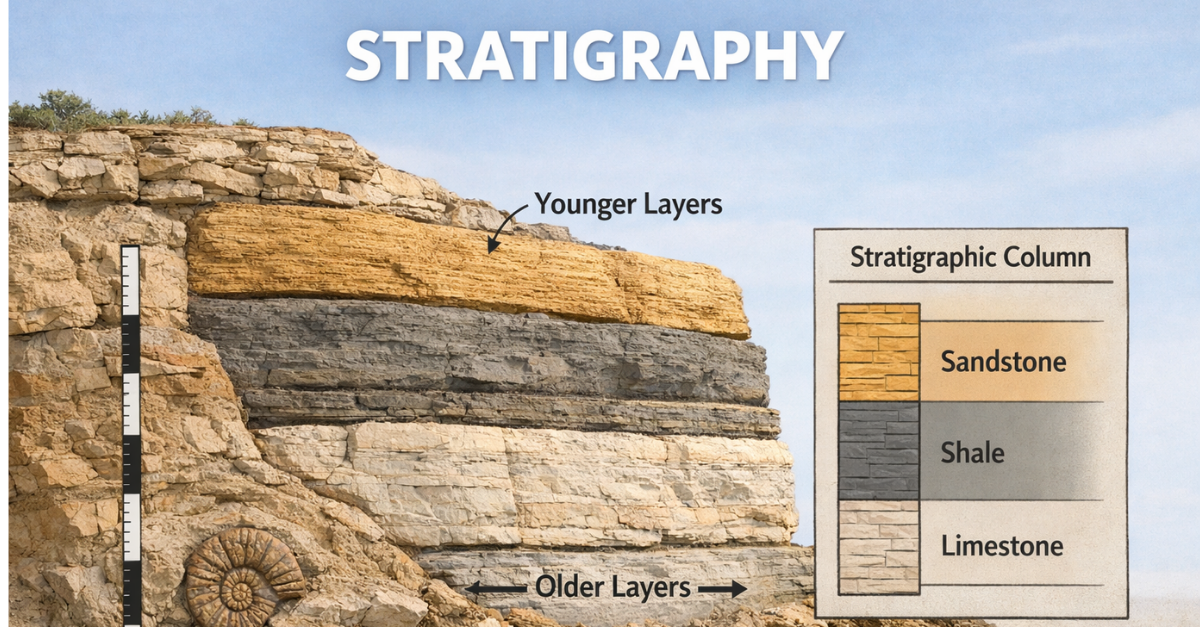
Rock layers work in the same way. The lower layers are usually older, and the upper layers are younger. Stratigraphy studies these layers and explains their order and meaning.

Definitions of Stratigraphy
Different geologists have described stratigraphy from different perspectives. Some focused on sedimentation, others on fossils, and some on geological time. However, there is a clear definition that is commonly accepted by geologists worldwide.
Stratigraphy is the study of the character, sequence, relationship, distribution, and origin of sedimentary and stratified rocks.
This definition is important because it includes both scientific understanding and practical geological work such as mapping and correlation
Scope of Stratigraphy
Stratigraphy is not limited to only clean, well-layered sedimentary rocks.
Rocks Included in Stratigraphy
Rocks Included in Stratigraphy
- Sedimentary rocks like sandstone, shale, and limestone.
- Layered volcanic rocks such as lava flows.
- Surface deposits formed by volcanic eruptions.
- Metamorphic rocks, as long as original layering can still be identified
Special Deposits.
Some deposits do not show clear layering but are still studied in stratigraphy, such as:
- Glacial till
- Wind-blown loess
- Cave fillings and collapse breccias
These deposits are important for reconstructing past environments.
Field Work: The Foundation of Stratigraphy
Stratigraphy relies largely on fieldwork, as direct observations can only be made during field studies.
- Thickness of layers
- Contacts between rocks
- Lateral extension of formations
- Relationship between different rock units
Supporting Sciences
Petrology helps identify rock composition
Paleontology provides fossil evidence
Subsurface stratigraphy (wells and cores) gives underground information
However, subsurface data alone is never enough. Surface observations are always necessary for correct interpretation
Successive Steps in Stratigraphy
1. Identification of Stratigraphic Units
The first step in stratigraphy is dividing rocks into units such as formations. These units help simplify complex rock successions.
It is important to understand that:
- Most stratigraphic units are practical, not natural
- They are defined to make geological work easier
- A unit is useful if it helps explain geology clearly
2. Determination of Stratigraphic Sequence
Stratified rocks are deposited in an orderly manner. Determining which layer came first is a basic task of stratigraphy.
Example:
If a sandstone layer lies below a shale layer, the sandstone is usually older. Even if folding or faulting occurs, stratigraphy helps restore the original order
3. Geological Mapping
Geological mapping shows how rock units are distributed:
On the surface
Below the surface
In three dimensions
Although mapping is largely practical work, it forms the base for advanced geological interpretation
Stratigraphic Correlation
Correlation means matching rock units of the same age in different areas.
Correlation is based on:
- Physical characteristics of rocks
- Fossil content
Example:
If marine fossils are found in two distant limestone layers, a stratigrapher may correlate them as deposits of the same ancient sea.
It is important to remember that correlation is always an interpretation, not an absolute fact.
Stratigraphic Interpretation
The highest goal of stratigraphy is interpretation. This means reconstructing:
- Ancient environments
- Paleogeography
- Geological history
Example:
If lower rock layers contain marine fossils and upper layers contain land plant fossils, it indicates that the area changed from sea to land over time.
Stratigraphy becomes a dynamic science when it goes beyond description and explains Earth’s changing environments.
Importance of Stratigraphy
As a Source of Basic Geological Information
Stratigraphy provides essential data for:
- Structural geology
- Sedimentology
- Paleontology
- Historical geology
Most geological research depends on stratigraphic frameworks.
Role in Economic Geology
Stratigraphy plays a major role in oil and gas exploration.
Example:
If an oil-bearing sandstone is found in one area, stratigraphers use correlation to predict where the same layer might exist in nearby regions.
Stratigraphy as a Unifying Science
Stratigraphy connects many branches of geology and organizes geological events in time. Because it deals directly with time, it provides the framework needed to understand Earth’s long history.
Stratigraphy and Geological Time
eology is a historical science, and stratigraphy is its timekeeper. Stratigraphy establishes:
Relative ages of rocks
Order of geological events
Relationships between different regions
Even with modern dating methods, stratigraphy remains essential for interpreting geological time.
Conclusion
Stratigraphy is the backbone of geology. It helps us read Earth’s layered history, understand past environments, and connect geological events across time and space. Without stratigraphy, geology would be a collection of disconnected facts.
For students, researchers, and professionals, understanding stratigraphy is essential. It is not just the study of rock layers—it is the study of Earth’s history itself.