What is Hydrology? Understanding Fresh Water Around Us

Have you ever wondered where the water in your glass comes from, how rivers flow, or why some areas experience floods while others face droughts? The science that answers these questions is called hydrology — the study of water. Specifically, hydrology focuses on fresh water that humans, plants, and animals use. Salt water, like in oceans, is studied separately under oceanography.
Hydrology is not just about knowing where water is. It is about understanding how water moves, how it is stored, and how humans interact with it.This knowledge allows us to use and protect our water resources wisely
Why Hydrology is Important
Hydrology is essential because water is critical for life, agriculture, cities, and the environment. Here’s why it matters:
Sustains life:
Humans are made of about 60% water, and plants and animals cannot survive without it.
Supports agriculture:
Farmers depend on rainfall, rivers, and groundwater for irrigation
Manages floods and droughts:
Proper understanding helps prevent disasters.
Maintains ecosystems:
Rivers, lakes, and wetlands rely on consistent water flows for fish, plants, and wildlife.
Example:
A village planning to build new wells will use hydrology to determine where groundwater is accessible and how much can be safely extracted.
The Two Main Approaches to Hydrology
Hydrology can be studied in two main ways, often overlapping in practice:
1. Earth Science Approach
ocuses on understanding natural processes: rivers, soil, landscapes, and groundwater.
Studies why water moves the way it does across landscapes.
Explains spatial patterns, such as why some areas have more water than others.
Example:
Scientists study how rain falling on a mountain flows into multiple rivers and which areas are at risk of flooding.
2. Engineering Approach
Focuses on practical solutions for human use.
Designs systems like dams, irrigation channels, and drainage networks.
Uses hydrological knowledge to prevent water-related problems.
Example:
Engineers design a city drainage system using rainfall data to ensure streets don’t flood after heavy storms.
Key Hydrological Processes
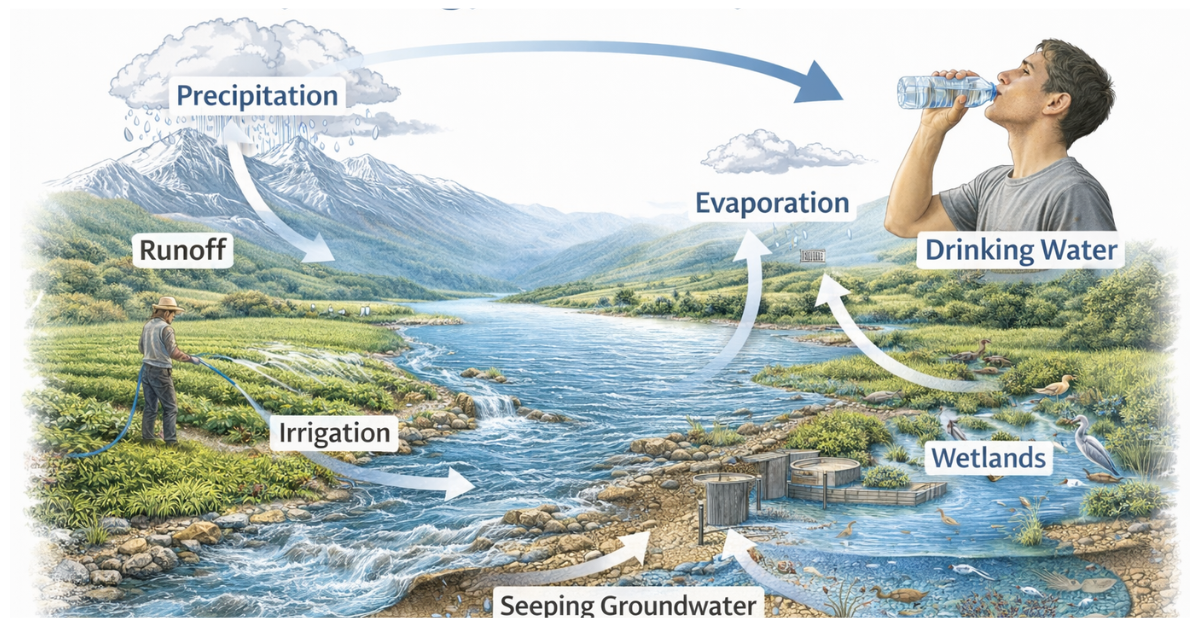
Hydrologists study the movement and storage of water through several processes:
Example:
A snowstorm contributes to rivers and groundwater as it melts.
Precipitation
Water that comes down from the sky in forms like rain, snow, sleet, or hail
Evaporation and Transpiration:
Water from lakes, rivers, soil, and plants turns into vapor and returns to the atmosphere.
Example:
Water from a wet field evaporates in summer; trees release water through transpiration.
Runoff:
Water moves across land or through soil into rivers, lakes, or underground storage
Example:
Rainwater on streets flows into drains and eventually into rivers.
Groundwater Storage:
Water seeps into the soil and fills underground reservoirs called aquifers.
Example:
Wells in towns access groundwater stored below the surface.
Hydrology and Human Interaction
Humans depend on water, and hydrology helps manage quantity and quality:
Water Quantity:
Limiting groundwater extraction during droughts to prevent shortages.
Example:
Limiting groundwater extraction during droughts to prevent shortages.
Water Quality:
Keeping water safe for drinking, recreation, and aquatic life.
Example:
Monitoring rivers to prevent pollution from factories.
Planning and Policy:
Hydrology informs decisions about building dams, irrigation projects, and flood control systems.
Example:
Using rainfall and river flow data to decide the location of a new reservoir.
Catchment Areas: The Natural Water Units
Hydrologists often study water at the scale of catchment areas (or river basins):
A catchment is an area of land where all water flows to a single river or outlet.
Helps hydrologists understand how rainfall, evaporation, runoff, and groundwater interact in a defined area.
Example: If it rains on a hill, water may travel downhill into a single river, showing the catchment’s boundaries.
Studying catchments helps in flood prediction, water management, and ecosystem protection.
Hydrology in Daily Life
Hydrology is everywhere in our daily lives
Drinking water:
Ensuring safe water supply to homes.
Farming:
Planning irrigation to avoid water waste.
Flood protection:
Designing levees, dams, and urban drainage.
Environmental protection:
Maintaining rivers, wetlands, and lakes for wildlife.
Example:
City planners consult hydrologists before building new neighborhoods to prevent waterlogging and ensure sufficient water supply.
Conclusion
Hydrology is more than just “the study of water.” It is about understanding fresh water, how it moves, where it is stored, and how humans interact with it. By studying water, hydrologists help us live safely, farm efficiently, prevent floods, and protect the environment. Water is precious and unevenly distributed, and hydrology shows us how to use it wisely.