What is Geology?

A Simple Explanation That Makes You Curious About the Earth
Have you ever looked at a mountain and wondered how it was formed? Or pick up a rock and think. “How old is this?” The Earth looks silent, but it has a very long story to tell.
Geology is the science that helps us understand that story.
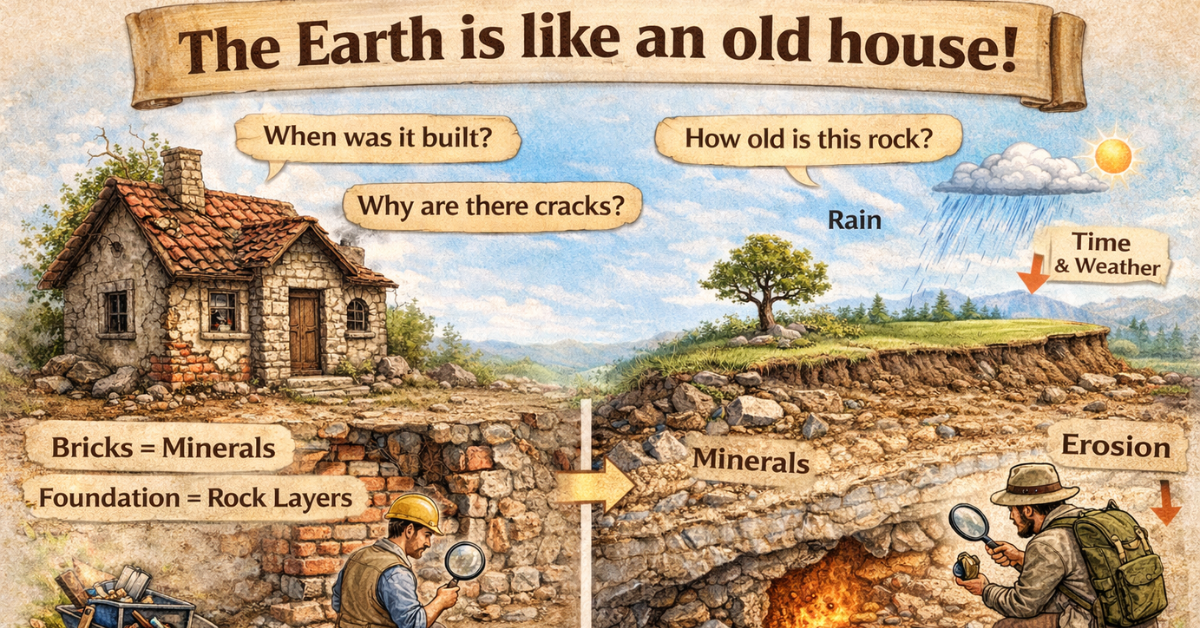
Imagine the Earth as an Old House
Think about an ancient house in your city. When you see that house, many questions come to your mind: When was it built? What materials were used? Why are there cracks in the walls? How did rain, heat, and time change it? An engineer studies the house by examining its bricks, foundation, and the damage caused by weather. Geology works in the same way. The Earth is like an old house, and geologists study it to understand what it is made of, how it was formed, and how it has changed over millions of years.
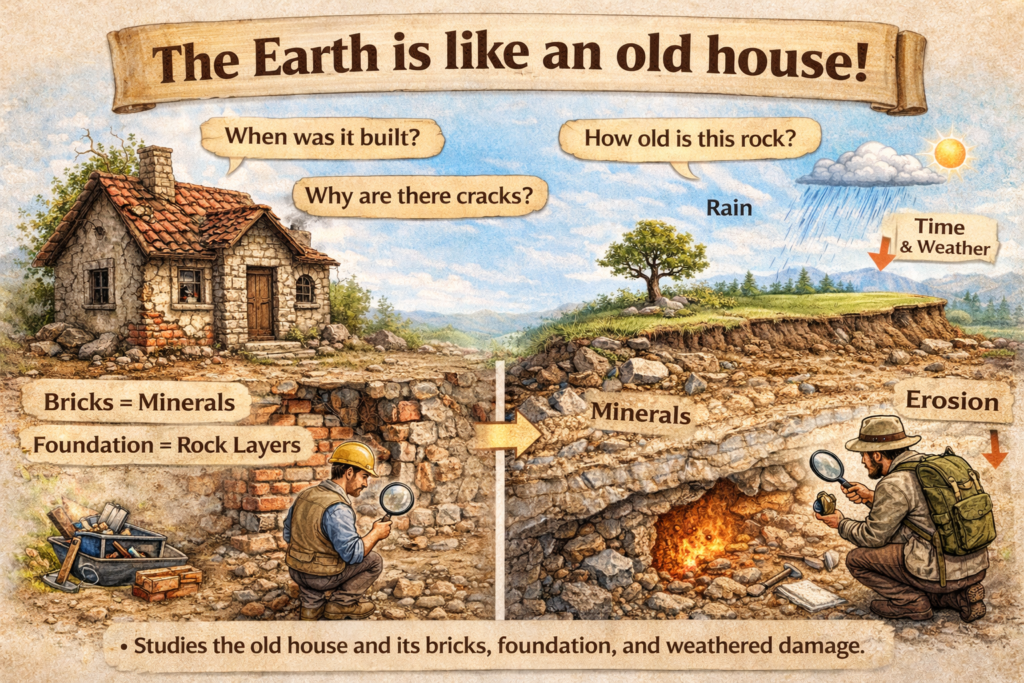
Now, imagine the Earth as a Book
Let us look at the Earth in another simple way. Imagine the Earth as a very ancient book. Each layer of the Earth is like a chapter, and each rock is like a page. Fossils are like old pictures inside a book. A geologist is the reader. By carefully reading this book, scientists learn about the Earth’s past. They study how the climate has changed and how life has evolved. That is why scientists often say that rocks record Earth’s history.
So, What is Geology?
Putting both examples together: Geology is the science that studies the Earth like an old house to understand its structure, and like a book to read its long history.
Geology Definition (Simple)
Geology is the branch of science that studies the Earth, its materials, its structure, and the processes that shape it over time. In simple words, geology helps us understand: rocks, minerals, Earth layers, natural processes, and changes over time.
Why is Geology Important in Real Life?
Geology is not just a subject in books. It is closely connected to our daily life. Geology helps us understand earthquakes, finding water underground, discover minerals and gemstones, explore oil, gas, and coal, build safe roads, bridges, and buildings, and study floods and landslides. Every time humans interact with the Earth, geology plays a role.
Who is a Geologist?
A geologist is a person who studies the Earth. A geologist can look at a rock and tell how it formed, study Earth layers to understand the past, and analyze natural hazards like earthquakes and landslides. You can think of a geologist as a detective of the Earth, finding clues hidden in stones and soil.
Is Geology Difficult?
Many students think geology is hard, but the truth is simple. Geology is difficult when it is taught without examples. When geology is explained using daily-life examples, simple language, and clear concepts, it becomes one of the most interesting sciences.
Why Students Choose Geology?
Students choose geology because it develops observation skills, connects science with nature, and offers careers in mining, oil and gas, GIS, environment, research, and hazard management. If you enjoy nature, mountains, and asking “why” and “how, geology is for you.
Final Thought
The Earth beneath your feet is not ordinary. It is full of stories, changes, and secrets. Every rock you see has a story. Geology teaches you how to read it. If you are curious about the Earth, geology might already be waiting for you.