Scope of Sedimentology and Its Applications

Introduction
Sedimentology is more than just the study of sand, mud, or gravel. It is the science that explores how Earth’s surface materials form, move, and settle. Every pebble, grain of sand, or clay particle has a story—how it came from a mountain, traveled through a river, and ended up in a delta or lake bed. By studying these materials, sedimentologists understand landscapes, climate history, and even resources vital to humans.
Understanding Sediment in Daily Life
Sediment surrounds us more than we realize. Road dust after rain, mud in puddles, sand on playgrounds, or clay used in pottery are all examples. These materials provide a small window into how Earth’s surface works. For instance, the sand that gets washed into rivers during monsoon rains will eventually settle in floodplains or deltas, contributing to fertile soils. Similarly, fine dust in urban areas, carried by wind, is part of the natural sediment transport process.
How Sediments Are Created
Sediments originate from rocks, either broken down physically or altered chemically. Physical weathering can be seen in mountains where temperature changes, water, or wind slowly break rocks into smaller pieces. For example, boulders cracking in deserts due to heat, or gravel forming from frozen water expanding in cracks. Chemical weathering changes the mineral composition, creating clay or silt. Rust forming on metal is a simple analogy for chemical reactions in rocks. Over years, these processes generate the sediments that cover Earth’s surface.
Transporting Sediments
Once sediments form, they rarely stay in one place. Rivers, glaciers, wind, and even gravity move sediments from highlands to basins. During floods, rivers can transport large sand and silt loads, forming fertile plains downstream. Glaciers slowly grind and carry rocks, leaving behind moraines when they melt. Strong winds pick up sand in deserts, creating dunes, or fine dust in cities. Even rainfall contributes by washing soil into streams. Understanding sediment movement helps in predicting erosion, soil fertility, and even river behavior.
Deposition: Where Sediments Settle
Sediments settle when energy decreases. Heavy particles like sand settle quickly, while fine clay travels farther. Deltas, floodplains, lake bottoms, and ocean shelves are classic depositional areas. Each environment leaves distinct sediment patterns. For example, calm lakes deposit fine silt in thin layers, whereas fast rivers deposit coarse gravel. By studying deposition, sedimentologists reconstruct past environments, helping us understand how rivers, lakes, or deserts evolved.
From Loose Sediment to Rock: Lithification
Loose sediments can turn into sedimentary rocks over time. Two main processes are involved:
Compaction:
The weight of overlying sediments presses down, squeezing out water and air.
Cementation:
Minerals such as calcite and silica crystallize between particles, binding them together.
Over centuries, sandy deposits become sandstone, muddy deposits form shale, and gravely sediments become conglomerate. By analyzing these rocks, scientists can tell the conditions under which they formed, such as river currents, wind intensity, or ancient shorelines.
Applications of Sedimentology
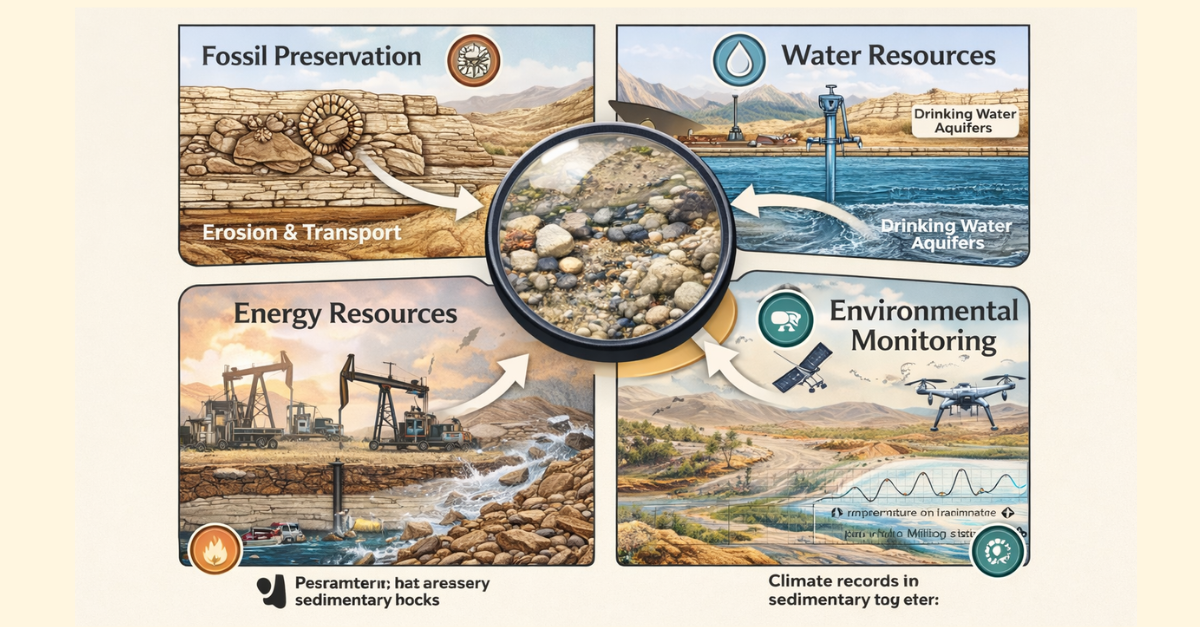
Fossil Preservation:
Most fossils are found in sedimentary rocks. These help scientists understand the evolution of life. For example, fossilized plants in shale reveal ancient wetlands.
Water Resources:
Groundwater is often stored in porous sedimentary rocks. Sandstone aquifers supply drinking water in many regions.
Energy Resources:
Petroleum and natural gas are trapped in sedimentary basins. Understanding sediment patterns is crucial for locating these resources.
Environmental Monitoring:
Sediment records show past climate changes. Ancient lake beds, desert dunes, and river deposits provide clues about rainfall, temperature, and wind patterns over millions of years.
Sedimentology in Modern Studies:
Sedimentology is not limited to field observation. Modern techniques include satellite imagery to monitor erosion, drones to map sediment patterns, and laboratory experiments to simulate river or wind flows. By combining these with chemical analysis, geologists can predict future sediment deposition, manage flood risks, and plan sustainable land use.
Daily Life Examples of Sedimentology:
- Farmers notice soil deposition after floods that enrich farmlands.
- Beach sand used in construction comes from ancient sedimentary processes.
- Clay pottery is made from sediments that formed millions of years ago.
- Urban dust and pollution studies rely on sediment movement analysis.
Conclusion:
Sedimentology explains how tiny particles from rocks, soil, and dust travel, settle, and eventually form rocks. Beyond academic interest, it has practical implications: predicting floods, conserving water, discovering oil, and studying climate history. Each grain of sediment tells a story about Earth’s past, and sedimentology is the key to reading that story. By understanding sedimentary processes, we not only unlock the past but also guide sustainable management of Earth’s surface resources.