Primary and Secondary Structures in Geology:

Introduction
Rocks may look boring, but they have amazing stories to tell! Structural geology is the study of these hidden patterns in rocks, helping scientists understand how the Earth has changed over millions of years. These patterns, called primary and secondary structures, reveal how rocks were formed and how they reacted to natural forces over time. In this article, we will explain these structures in a way that even a 10-year-old can understand, include real-world examples from different countries, and show how they impact our daily life and human activities.
What Are Primary Structures?
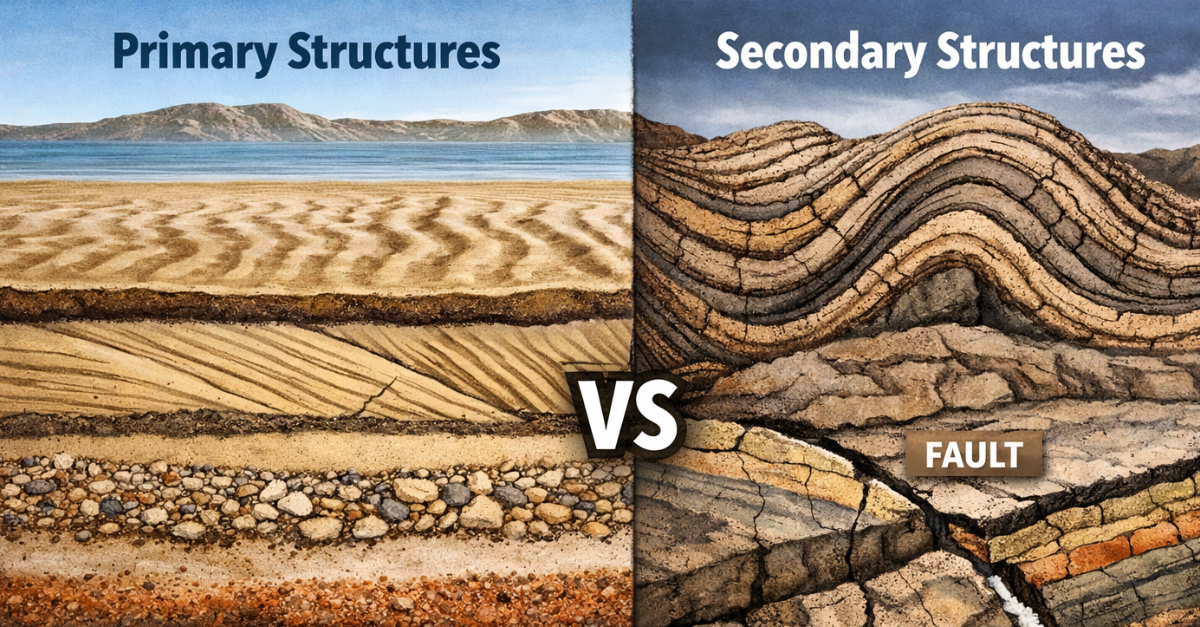
Primary structures are like the first sketches of the Earth’s story. They form when rocks are first deposited, before they harden into solid rock. These features give us clues about the environment in which the sediment was originally deposited.
Common Examples of Primary Structures:
Bedding / Stratification: Layers of sediment stacked on top of each other, often seen in cliffs or canyon walls.
Cross-bedding: Slanted layers within horizontal beds, like what you see in sand dunes or riverbeds.
Ripple Marks: Tiny ridges formed by water or wind currents.
Graded Bedding: Layers that go from coarse grains at the bottom to fine grains on top, like shaking a jar of mixed nuts.
Mud Cracks: Small cracks that form when wet mud dries.
Daily Life Example:
Imagine pouring sand into a sandbox. The layers you see forming naturally, with ripples from moving your hand or water, represent primary structures. Even kids can observe and understand this simple process.
Countries Where Primary Structures Are Common:
United States: Grand Canyon, Colorado — clear bedding and ripple marks.
Australia: Coastal sand beds and Great Barrier Reef sediments.
India: Narmada Valley — visible sedimentary layers.
South Africa: Karoo Basin — thick sequences of sedimentary rocks.
Egypt: Nile River delta — cross-bedding and graded beds.
Primary structures are not just interesting—they help engineers and planners predict how rocks will behave when building structures like dams, roads, and tunnels.
What Are Secondary Structures?
Once rocks are deposited and hardened, they can still change! Secondary structures form after the rocks have become solid, usually due to stress, pressure, or tectonic movements. These structures tell us about the forces that shaped the Earth’s crust over millions of years.
Common Examples of Secondary Structures:
Folds: Bends in rock layers caused by compression, like bending a sandwich.
Fractures / Joints: Cracks in rocks without much movement, like a broken chocolate bar.
Faults: Cracks along which rocks have moved.
Veins: Minerals that fill cracks in rocks, like icing in a broken cookie.
Daily Life Example:
Think of bending a chocolate bar. The cracks and folds that appear represent secondary structures, showing how solid material reacts to stress.
Countries Where Secondary Structures Are Common:
Nepal / Himalayas: Folded rocks from mountain formation.
Chile / Andes: Complex folds and active faults.
Turkey: North Anatolian Fault — prominent fractures and movements.
USA: San Andreas Fault — major fracture zone
India: Aravalli Range — folded metamorphic rocks.
Secondary structures are crucial for understanding earthquakes, landslides, and safe construction in tectonically active areas.
Explaining Primary and Secondary Structures to Everyone
Sometimes geological terms can feel too complicated, but here’s a way to make them simple:
Primary Structures: “Imagine you are pouring sand into a sandbox. The layers and ripples that form naturally before the sand becomes hard are primary structures.
Secondary Structures: “Once the sand hardens, if you press it, bend it, or it cracks, the bends and cracks are secondary structures.”
This analogy works for kids, students, and anyone without a science background. Using daily life examples makes rocks come alive!
History of Primary and Secondary Structures
Observing primary structures began in the early 19th century when geologists studied sedimentary layers, ripple marks, and bedding.
Secondary structures were systematically studied by European geologists such as James Hall (1811–1898) and Roderick Murchison (1792–1871), who analyzed folds, faults, and fractures in mountain belts.
Over time, these observations were integrated into structural geology, giving scientists tools to interpret Earth’s past and understand tectonic forces.
Importance in Daily Life and Human Activities
Engineering: Knowing rock structures prevents building disasters. For example, dams and bridges need stable rock foundations.
Resource Exploration: Minerals, oil, and gas are often trapped along folds and fractures. Understanding structures increases safety and efficiency.
Natural Hazard Prediction: Earthquake zones often coincide with secondary structures like faults. Mapping these can save lives.
Education and Awareness: Simple examples like sand layers and chocolate bars help students and the public appreciate Earth’s dynamics
Daily Life Example:
Observing river sediment layers helps predict flooding events. Mountains show folds that tell geologists about tectonic activity. Mining veins follow fractures that indicate safe extraction paths.
Key Takeaways
Primary structures form when rocks are made (layers, ripples, bedding).
Secondary structures form after rocks are solid (folds, fractures, faults).
These structures are visible around the world: USA, India, Nepal, Australia, Chile, South Africa.
Everyday analogies make geological processes simple and engaging.
Studying these structures is essential for engineering, resource management, environmental safety, and understanding Earth’s history.
First systematic studies by 19th-century geologists formalized these terms in structural geology.
Structural geology shows that even seemingly ordinary rocks have incredible stories to tell. By observing primary and secondary structures, we can read the Earth’s past, predict its movements, and make safer choices for the future.