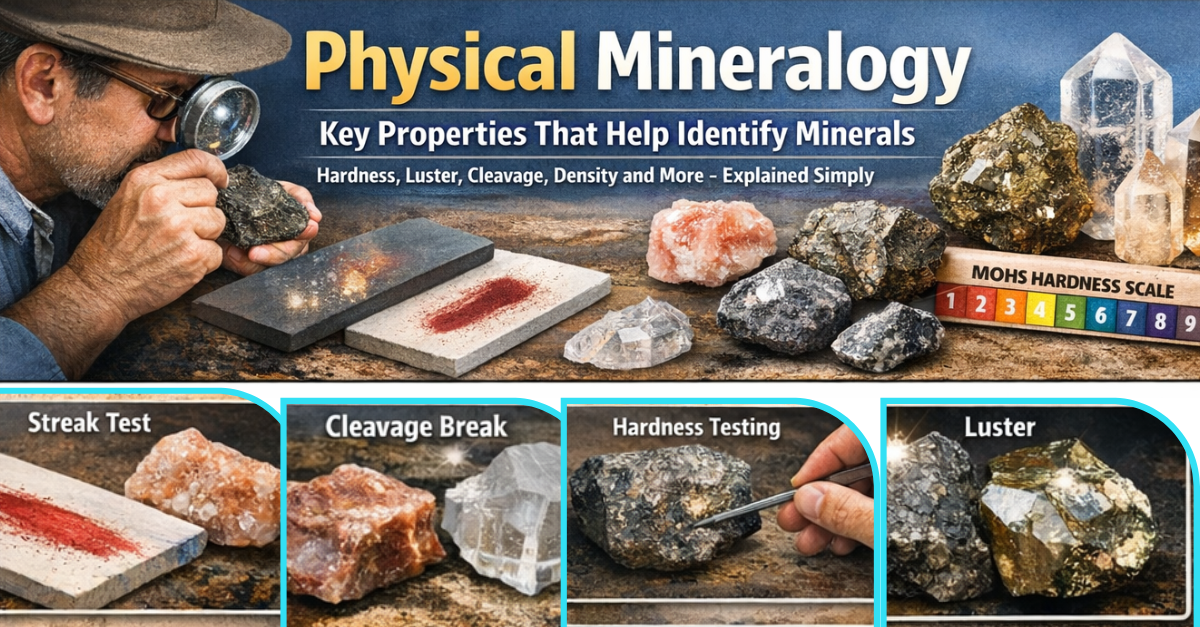
Physical Mineralogy: Key Properties & Importance
Explore the main physical properties of minerals, their significance in geology, industry, and everyday life for accurate identification and practical use

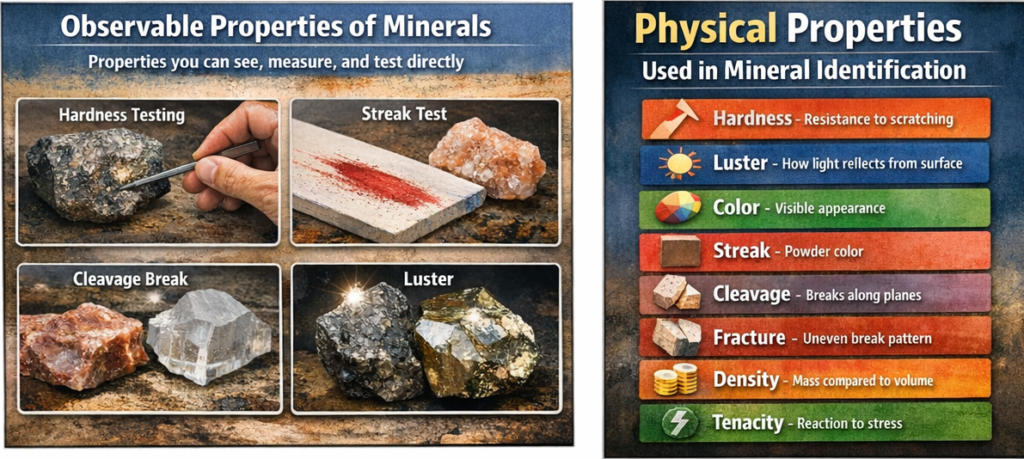
Minerals are the fundamental building blocks of our Earth, and understanding their physical properties is an essential part of geology. Physical mineralogy studies those aspects of minerals that can be directly observed or measured. This knowledge is not only vital for geologists but also for engineers, jewelers, and anyone who works with minerals in daily life. This article explains the main physical properties of minerals and highlights why they are important in study and real-world use.
1. Hardness
Hardness measures how well a mineral can withstand scratching or abrasion. The Mohs Hardness Scale is commonly used to measure it, ranging from 1 (softest) to 10 (hardest).
For example, talc is very soft and ranks at the lowest end of the hardness scale, whereas diamond is extremely hard and occupies the highest position.
Importance:
- Crucial for cutting and polishing gemstones.
- Selecting materials for construction and industrial purposes, such as quartz for glass and concrete.
- Hardness also aids in mineral identification and helps determine their industrial applications.
2. Luster
Luster describes how a mineral’s surface reflects light. Minerals typically display either metallic or non-metallic luster.
Example
Pyrite exhibits a metallic shine, whereas Quartz shows a non-metallic luster.Talc is very soft and ranks at the lowest end of the hardness scale, whereas diamond is extremely hard and occupies the highest position.
Importance:
- Essential for identifying minerals.
- Plays an aesthetic role in jewelry and decorative stones.
- Luster also provides clues about a mineral’s internal structure and composition.
3. Color and Streak
Color is the visible hue of a mineral but can sometimes be misleading due to impurities.
Streak refers to the color of the mineral in powder form, obtained by rubbing it on a porcelain plate.
Example:
Hematite appears black on the surface but leaves a red-brown streak
Importance:
- Helps in accurate mineral identification.
- Crucial for classifying minerals in industrial processes.
- By combining color and streak information, geologists can determine a mineral’s authenticity and quality.
4. Cleavage and Fracture
Cleavage is a mineral’s tendency to break along specific planes, while fracture describes an irregular break
Example:
- Galena → cubic cleavage
- Calcite → rhombohedral cleavage
- Quartz → irregular fracture
Importance:
- Guides gem cutting and shaping.
- Helps geologists identify minerals in the field.
- Useful in assessing durability for construction materials.
- Cleavage and fracture provide insight into a mineral’s structural integrity and industrial usability.
5. Density
Density measures a mineral’s mass per unit volume
Example:
Gold has a density of 19.3 g/cm³, whereas Bauxite has a density of 2.5 g/cm³.
Importance:
- Helps identify valuable ores and metals.
- Guides material selection in construction and manufacturing.
- Density analysis allows us to understand a mineral’s economic and practical value.
6. Elasticity and Tenacity
Elasticity refers to a mineral’s ability to return to its original shape after stress, while tenacity describes how brittle, malleable, or tough it is.
Example:
Gold and Silver are highly malleable, whereas Quartz is brittle.
Importance:
- Determines suitability for industrial applications such as wiring or sheets.
- Assesses durability for construction materials.
- Understanding elasticity and tenacity helps in safe and efficient use of minerals.
7. Response to Heat and Electricity
Some minerals show unique reactions to heat and electricity.
Example:
Graphite conducts electricity, while Pyrite can produce sparks under heat.
Importance:
- Crucial for selecting materials in electronics and semiconductors.
- Helps in designing fire-resistant materials and heat sensors.
- This knowledge reflects a mineral’s functional and industrial significance.
Importance of Physical Mineralogy
Studying physical mineralogy goes beyond just rocks and stones; it is also critical for understanding the practical applications of minerals in everyday life and industry.
Geologists:
Identify minerals and study formation processes.
Engineers:
Select the right minerals for construction, electronics, and manufacturing.
Health Experts:
Understand nutritional minerals and their availability.
Jewelry Industry
Check the quality and authenticity of gemstones
By analyzing physical properties, we can better understand the structural, chemical, and economic importance of minerals.
Conclusion
Through physical mineralogy, we study properties like hardness, color, luster, cleavage, density, elasticity, and response to heat or electricity. These properties not only help identify minerals but also define their applications in industry, daily life, and scientific research. Whether you are a geologist, engineer, or mineral enthusiast, knowledge of physical mineralogy allows you to use Earth’s resources efficiently and responsibly.