What Is Paleontology? Simple Explanation

Introduction
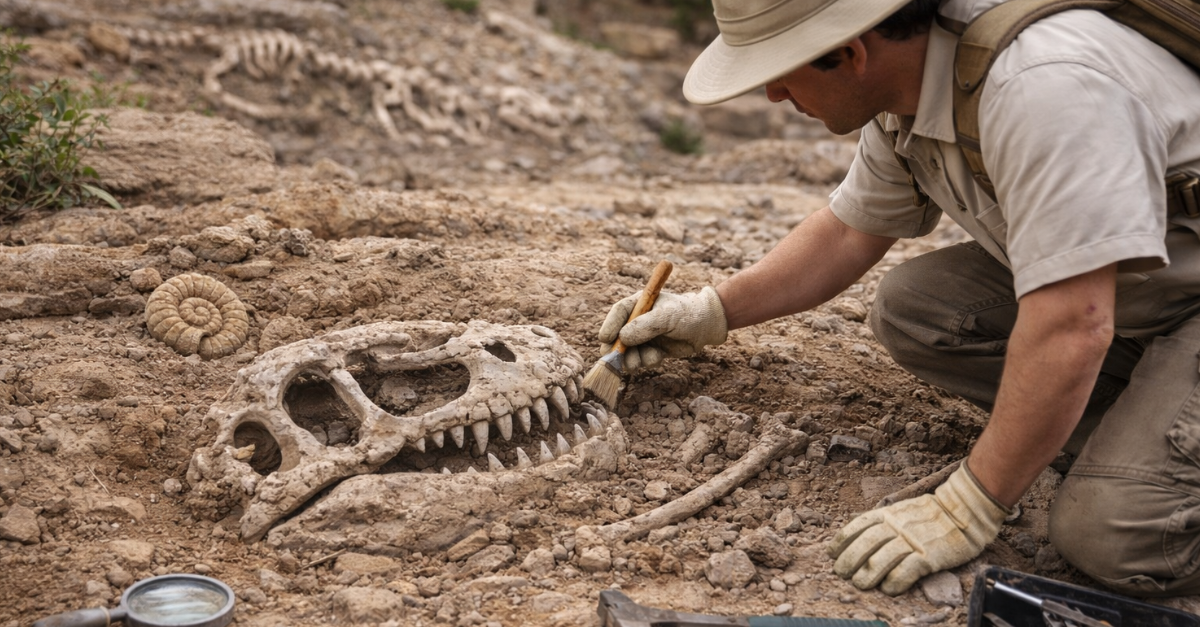
Paleontology is the branch of science that studies ancient life on Earth. It focuses on organisms that lived long before humans existed, including plants, animals, and tiny life forms. These organisms are studied through fossils preserved in rocks. Paleontology helps us understand how life started, how it changed, and how Earth became the way it is today.
What Does Paleontology Study?
Paleontology studies different aspects of ancient life, such as:
- Living organisms that existed on Earth long before the modern world developed
- Extinct species like dinosaurs and ancient sea creatures
- Changes in life forms over long periods of time
- Ancient ecosystems, including oceans, forests, and deserts
By studying these areas, scientists learn how life adapted to changing environments.
What Are Fossils?
Fossils are traces or remains of life forms that lived on Earth in the distant past. They are not always complete skeletons. Fossils can be:
- Bones, teeth, or shells
- Leaf impressions or fossil wood
- Footprints and track marks
- Burrows and feeding marks
Most fossils are found in sedimentary rocks because these rocks form slowly in layers, allowing remains to be buried and preserved.
How Are Fossils Formed?
Fossil formation is a slow process. It usually happens when:
- A plant or animal dies and is quickly buried by mud, sand, or sediment
- Soft parts decay, but hard parts remain
- Minerals replace the original material over time
- The remains turn into stone
It takes a very long time for this process to complete, sometimes millions of years.
Why Is Paleontology Important?
Paleontology is important because it helps us:
- Understand the evolution of life
- Learn about climate changes in the past
- Study mass extinction events
- Discover how ancient organisms lived and interacted
These studies also help scientists predict how life may respond to future environmental changes.
Relationship Between Paleontology and Geology
Paleontology and geology are closely linked. Geology helps paleontologists:
- Identify rock layers that contain fossils
- Determine the age of fossils
- Understand how fossils were preserved
Without geological knowledge, fossils cannot be correctly interpreted.
Simple Real-Life Example
Imagine Earth as a museum. The rocks are the display shelves, and fossils are the objects placed on them. Paleontology is the science that explains what those objects are and where they came from.
Conclusion
Paleontology allows us to explore Earth’s deep past. By studying fossils and rock layers, scientists uncover the history of life and the changes that shaped our planet. This field plays an important role in understanding both the past and the future of life on Earth.