
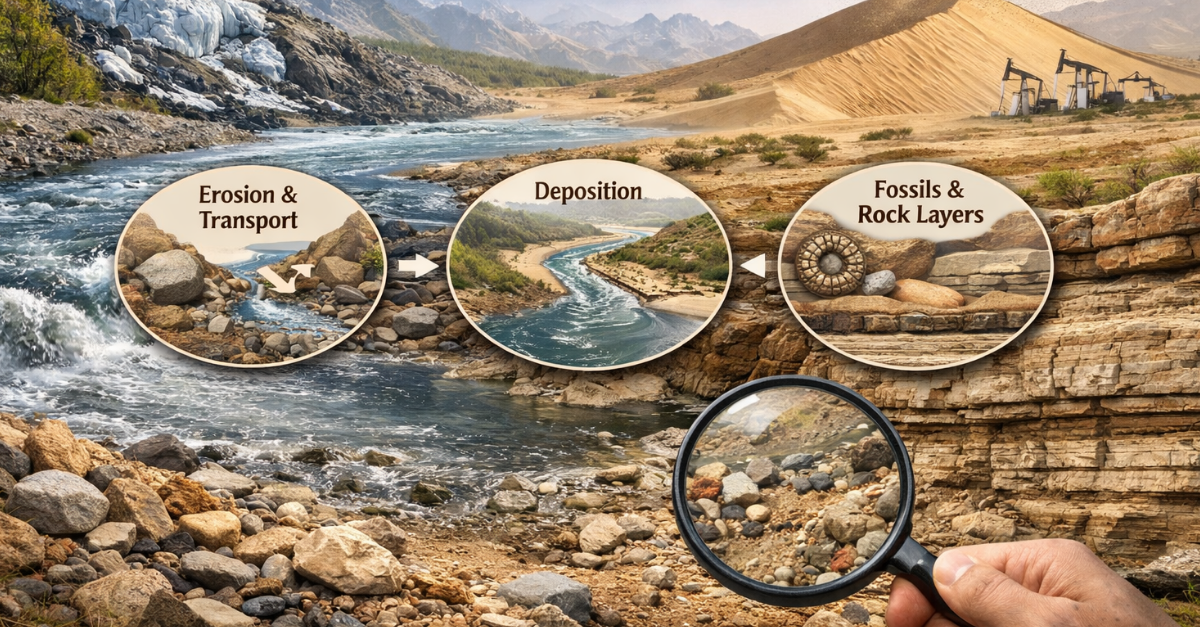
What Is Sedimentology? Simple Explanation

When we walk along a riverbank, a beach, or even a construction site, we often see sand, soil, pebbles, and mud. These materials may look ordinary, but they are actually the building blocks of many rocks on Earth. The scientific study that explains where these materials come from, how they move, and where they finally settle is called sedimentology.
Sedimentology is a branch of geology that focuses on sediments, the processes that create them, and the sedimentary rocks formed from them. In simple words, sedimentology helps us understand how loose particles turn into layered rocks and what stories those layers tell about Earth’s past.
Understanding Sediments in Everyday Life
Sediments are small pieces of solid material that come from the breakdown of rocks or from substances that settle out of water. We encounter sediments in daily life more often than we realize.
For example, when rainwater flows over roads and fields, it carries fine soil particles into drains and rivers. The mud that settles at the bottom of a pond after heavy rain is sediment. Sand on a beach, dust that gathers on windowsills, and clay used to make bricks are all forms of sediment.
Sedimentology studies these materials scientifically, not just as loose particles, but as part of a larger natural system that shapes landscapes and records Earth’s history.
How Sediments Are Formed
The journey of sediments usually begins with weathering. Weathering is the process by which rocks break down at or near the Earth’s surface. This can happen in two main ways.
- One way is physical weathering. For instance, water enters cracks in rocks, freezes during cold nights, and expands. Over time, this repeated freezing and thawing breaks the rock into smaller pieces. Similarly, temperature changes in deserts can cause rocks to crack and fragment.
- Another way is chemical weathering. Rainwater, which is slightly acidic, reacts with minerals in rocks. This reaction slowly changes the rock’s composition, turning hard minerals into softer materials like clay. A common daily example is rust forming on iron; a similar chemical process happens naturally in rocks.
Through these processes, large solid rocks gradually turn into small particles that we call sediments.
Transport of Sediments: How They Move
- Once sediments are formed, they rarely stay in one place. Natural forces transport them from their source to new locations.
- Running water is the most important transporting agent. Rivers carry sand, silt, and gravel from mountains to plains and eventually to seas. During floods, rivers can move very large amounts of sediment, which explains why floodplains are usually fertile.
- Wind is another powerful transporter, especially in dry regions. Fine sand and dust can be lifted by strong winds and carried over long distances. Dust storms that cover cities with a thin layer of soil are a good everyday example of wind-transported sediments.
- Ice also plays a role in colder regions. Glaciers slowly move downhill, scraping rocks and carrying broken material with them. When glaciers melt, they leave behind piles of sediment.
Sedimentology studies how these transport processes affect the size, shape, and distribution of sediments.
Deposition: Where Sediments Settle
Sediments do not move forever. When the energy of water, wind, or ice decreases, sediments begin to settle. This process is called deposition.
For example, when a river enters a lake or the sea, its speed decreases. As a result, heavier particles like sand settle first, while finer particles like clay travel farther before settling. This is why river deltas often show clear layers of different sediment types.
Similarly, when wind loses strength, sand dunes form in deserts. In calm water bodies, very fine sediments settle slowly, creating thin layers over time.
Sedimentology examines these depositional environments to understand how and why sediments accumulate in specific patterns.
From Loose Sediment to Solid Rock
- Loose sediments do not always remain loose. Over long periods, they can turn into solid sedimentary rocks through a process called lithification.
- As more sediments pile up, the weight of the upper layers presses down on the lower ones. This pressure squeezes out water and reduces the space between particles. This step is known as compaction.
- At the same time, minerals dissolved in water can crystallize between sediment particles and act like glue. This process is called cementation. Together, compaction and cementation transform loose sediments into hard rock.
Over time, sandy deposits harden into sand-rich rock, muddy layers compact into fine-grained rock, and pebble-rich sediments form coarse, cemented rock masses. These changes reflect the gradual lithification of sediments under pressure and mineral bonding. Sedimentology helps explain how these transformations occur and what environmental conditions existed during rock formation.
Why Sedimentary Rocks Are Important
Sedimentary rocks cover large areas of the Earth’s surface and play a crucial role in human life.
- Most fossils are found in sedimentary rocks. These fossils provide direct evidence of past life and help scientists understand how plants and animals evolved over millions of years.
- Sedimentary rocks are also important for water resources. Groundwater is commonly stored in sedimentary formations like sandstone and limestone. Many wells tap into these rocks to supply drinking water.
- In addition, major oil and gas reserves occur in sedimentary basins. Understanding sedimentary processes helps geologists locate energy resources.
- Sedimentary layers also preserve records of past climates, such as ancient deserts, rivers, and seas. Such evidence helps scientists understand how Earth’s climate has shifted over long periods of time..
Sedimentology and Earth’s History
One of the main goals of sedimentology is to interpret the stratigraphic record, which is the layered arrangement of sedimentary rocks.
Each layer represents a period of deposition. By studying the thickness, composition, and structure of layers, sedimentologists can reconstruct past environments. For example, cross-bedded sandstones may indicate ancient deserts, while finely layered mudstones may suggest calm lake or deep-sea conditions.
In this way, sedimentology allows scientists to read Earth’s history layer by layer, much like reading pages in a book.
Sedimentology Compared to Other Fields
Sedimentology is closely related to other branches of geology but has its own focus.
- Stratigraphy deals mainly with the arrangement and correlation of rock layers, while sedimentology concentrates on the processes that created those layers.
- Petrology studies rocks in general, including igneous and metamorphic types. Sedimentology focuses specifically on sediments and sedimentary rocks.
By working together, these fields provide a complete picture of Earth’s surface processes.
Conclusion
Sedimentology is the science that explains how everyday materials like sand, mud, and gravel are formed, transported, deposited, and transformed into rocks. Through simple processes acting over long periods, sediments shape landscapes, store water and energy resources, preserve fossils, and record Earth’s history.
By studying sedimentology, we gain a deeper understanding of the natural world around us and learn how the Earth has changed through time. Even the smallest grain of sand has a story to tell, and sedimentology helps us read that story.

SV888casino is bringing the real casino feels straight to your screen. Awesome graphics, live dealers, the whole shebang. Place your bets today: sv888casino