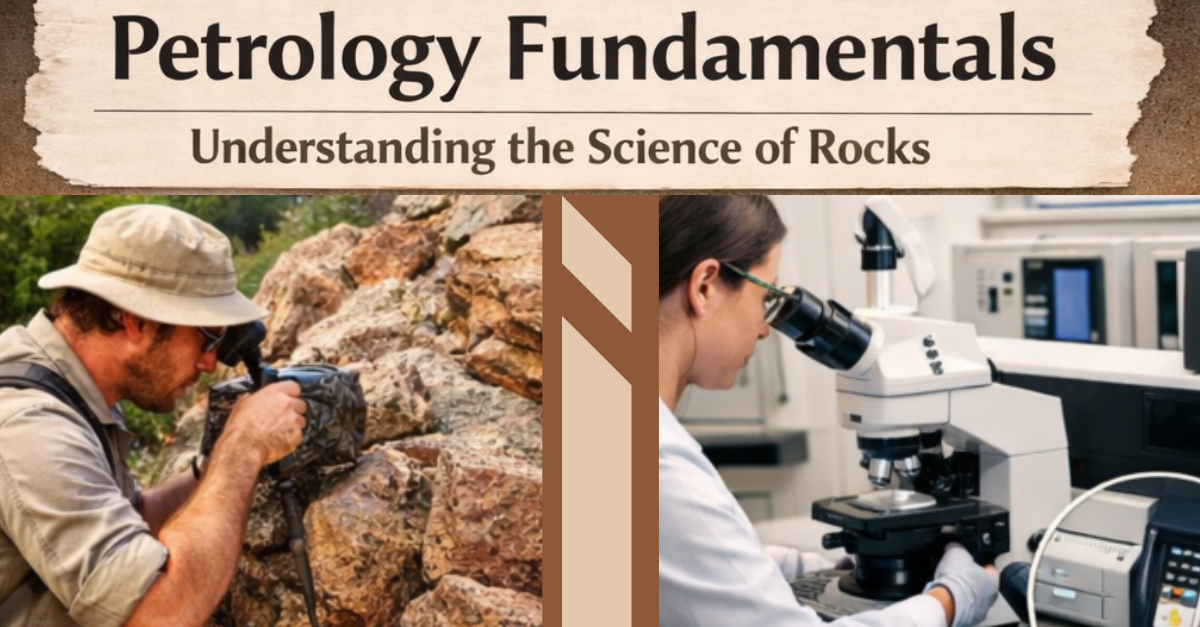
Petrology is a fascinating branch of geology that focuses on the study of rocks—their composition, origin, and history. While most people see rocks as simple stones scattered on the ground, each rock contains a story of Earth’s formation and transformation. Petrology allows scientists to decode these stories and understand not only how rocks form but also how they shape our planet’s surface, natural resources, and ecosystems.
In this article, we will explore what petrology is, why it is considered a hybrid science, and the role of petrologists in understanding Earth’s history, all with real-life examples and applications.
What is Petrology?
Petrology is the scientific study of rocks. Rocks are naturally occurring solid masses made of minerals, mineral-like substances, or organic materials formed through geological processes. Petrologists examine rocks to uncover information about the Earth’s past, such as volcanic activity, sedimentation patterns, and metamorphic transformations.
Unlike general geology, which may study landforms, soil, or minerals individually, petrology focuses specifically on rocks as a whole. Rocks are not just building blocks of the Earth; they are records of its history.
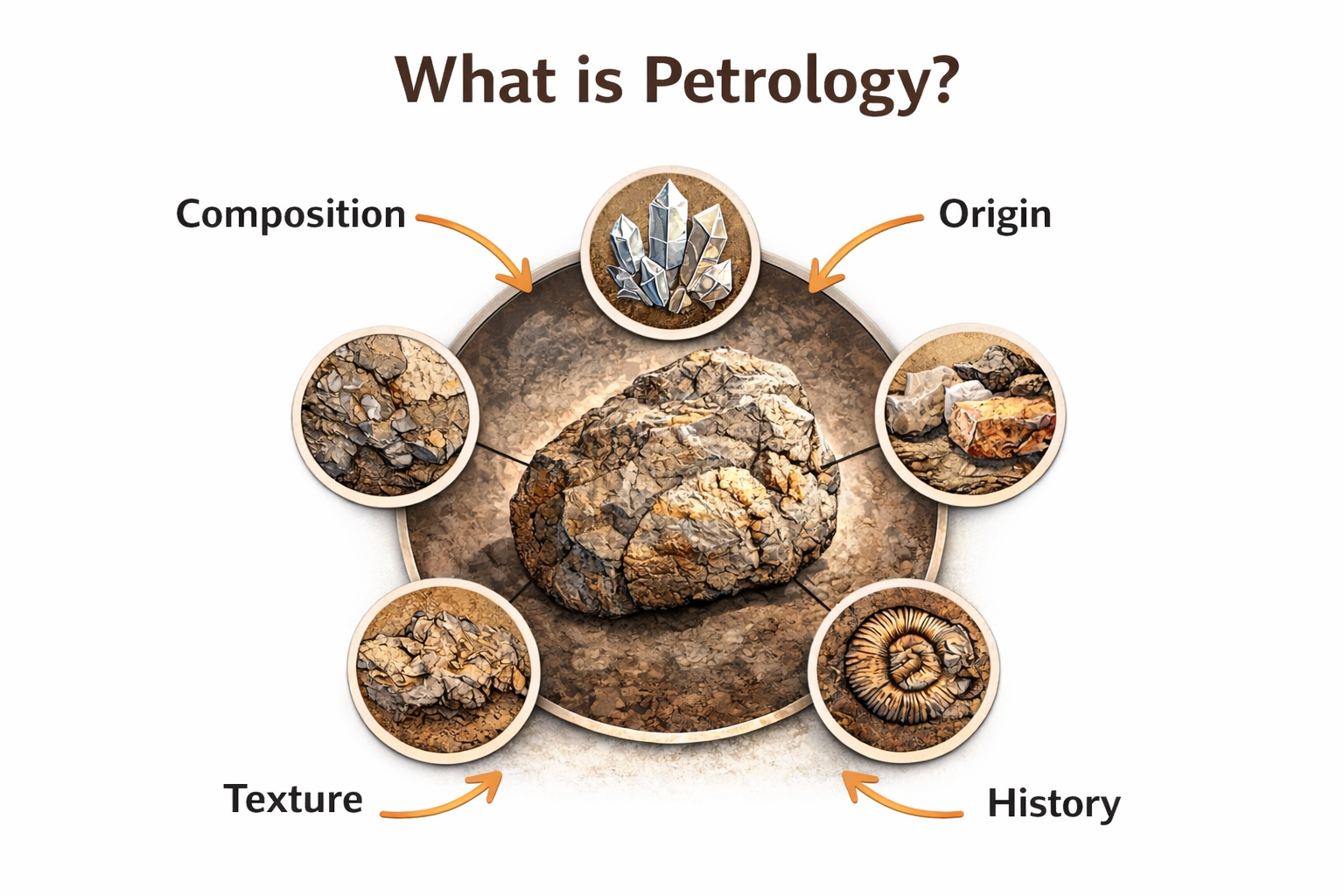
Visual representation of the fundamentals of petrology, showing a central rock connected to Composition, Origin, Texture, and History
Rocks and Their Information
Each rock contains clues about its formation environment:
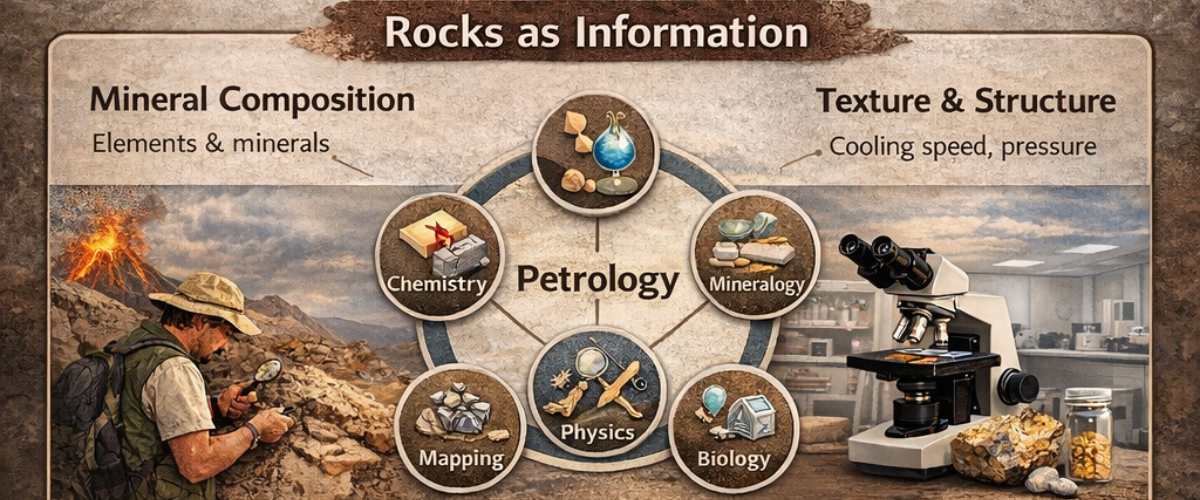
Infographic illustrating rocks as carriers of geological information, showing mineral composition, texture, cooling & pressure effects, and petrology as a hybrid science with chemistry, mineralogy, physics, biology, and mapping
Mineral composition:
Shows which elements and compounds were present during formation.
Texture and structure:
Indicates whether the rock formed slowly underground, erupted as lava, or underwent heat and pressure transformations.
Layering and fossils:
Reveal information about past climates, life, and sedimentary processes. For example, a sandstone layer may indicate ancient riverbeds, while a basalt flow can reveal volcanic activity millions of years ago.
Petrology: A Hybrid Science
Petrology is considered a hybrid science because it integrates multiple scientific disciplines:
Chemistry:
Determines the elemental composition of rocks.
Mineralogy:
Studies the minerals present in rocks and their properties.
Physics:
Helps understand rock formation processes, density, and pressure effects.
Biology:
Explains fossils and organic sediments in rocks.
Geological mapping:
Locates rock formations and their relationships in the field.
This combination allows petrologists to analyze rocks comprehensively—from field observations to laboratory analysis.
The Role of Petrologists:
Petrologists are scientists who specialize in studying rocks to uncover their history and formation processes. Their work is crucial in both academic research and practical applications.
Field Studies:
Petrologists often begin their work in the field, examining rocks in outcrops and hand samples. They observe:
Grain size and texture
Mineral composition
Rock layering and structures:
For instance, in a graniteoutcrop, the presence of both large and small feldspar crystals may indicate that the rock crystallized in two stages—first slowly underground and later rapidly as it reached the surface.
Laboratory Studies
Many petrologists also work in labs, where they analyze rock samples using specialized equipment.
Reveal mineral relationships and textures in thin sections of rock.
Petrographic microscopes:
X-ray fluorescence (XRF):
Measures elemental composition quickly and accurately.
Neutron activation analysis (INAA) and ICP-MS are advanced techniques used to detect tiny amounts of elements and isotopes in rocks, helping scientists understand their detailed composition.
Laboratory studies allow scientists to uncover details invisible to the naked eye, helping to reconstruct the rock’s formation history.
Why Petrology is Important ?
Petrology is not just an academic pursuit; it has real-world applications.
Understanding Earth’s History
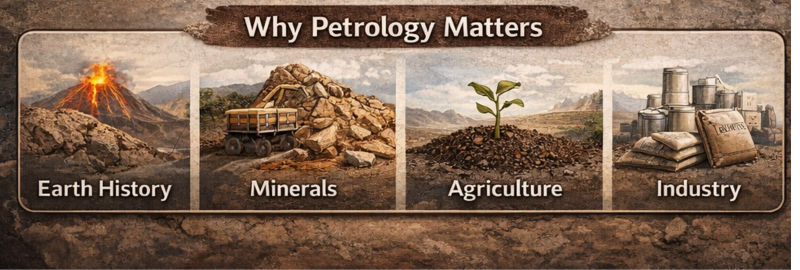
Illustration showing the real-world importance of petrology, including Earth history, minerals, agriculture, and industry.”
By studying rocks, petrologists can reconstruct past geological events, such as:
Volcanic eruptions
Mountain formation
Ancient river systems
Shifts in climate and environment
For example, fossil-rich limestone layers provide evidence of marine life millions of years ago, while metamorphic rocks in mountain ranges indicate intense pressure and heat during tectonic collisions
Mineral Resources and Industry
Rocks are often the source of valuable minerals and metals. Petrology helps in:
Identifying ore deposits, such as platinum, gold, or copper.
Understanding how to mine resources efficiently.
Developing construction materials like cement, ceramics, and glass.
A real-life example is the Stillwater Igneous Complex in Montana, where petrologists studied the rock to locate and extract platinum and palladium efficiently.
Agriculture and Soil Science
Petrology also affects everyday life through soil formation. Weathered rocks provide minerals essential for fertile soils, which support agriculture. For instance, young basaltic soils in Hawaii support sugarcane plantations, even though the rock itself is relatively young and volcanic.
Subfields of Petrology
Petrology has several specialized areas:
Igneous petrology:
Studies rocks formed from molten material (magma or lava).
Example: Granite, Basalt.
Sedimentary petrology:
Focuses on rocks formed from sediments and organic material.
Example: Sandstone, Limestone.
Metamorphic petrology:
Examines rocks transformed by heat, pressure, or chemical processes.
Example: Marble, Slate
Petrography:
The description and classification of rocks using field and microscopic techniques.
Petrology in Daily Life
Even if we don’t notice, petrology influences daily life:
Buildings and Roads:
Rocks provide the raw materials for concrete, asphalt, and stone structures.
Cement and Ceramics:
Derived from limestone and clay, which are studied by petrologists for their properties.
Electronics:
Knowledge from crystallography (developed through rock studies) contributed to the design of microchips and electronic materials. By understanding rocks, we can manage resources better, plan construction, and even predict geological hazards.
Conclusion
Petrology reveals that rocks are more than just solid objects—they are records of Earth’s complex history and dynamic processes. By studying rock composition, origin, and transformations, petrologists uncover stories that inform us about past climates, natural resources, and even industrial applications.
From examining a granite outcrop in the desert to analyzing limestone fossils under a microscope, petrology connects science with everyday life. Understanding rocks allows us to not only appreciate the beauty of Earth’s surface but also use its resources responsibly.