
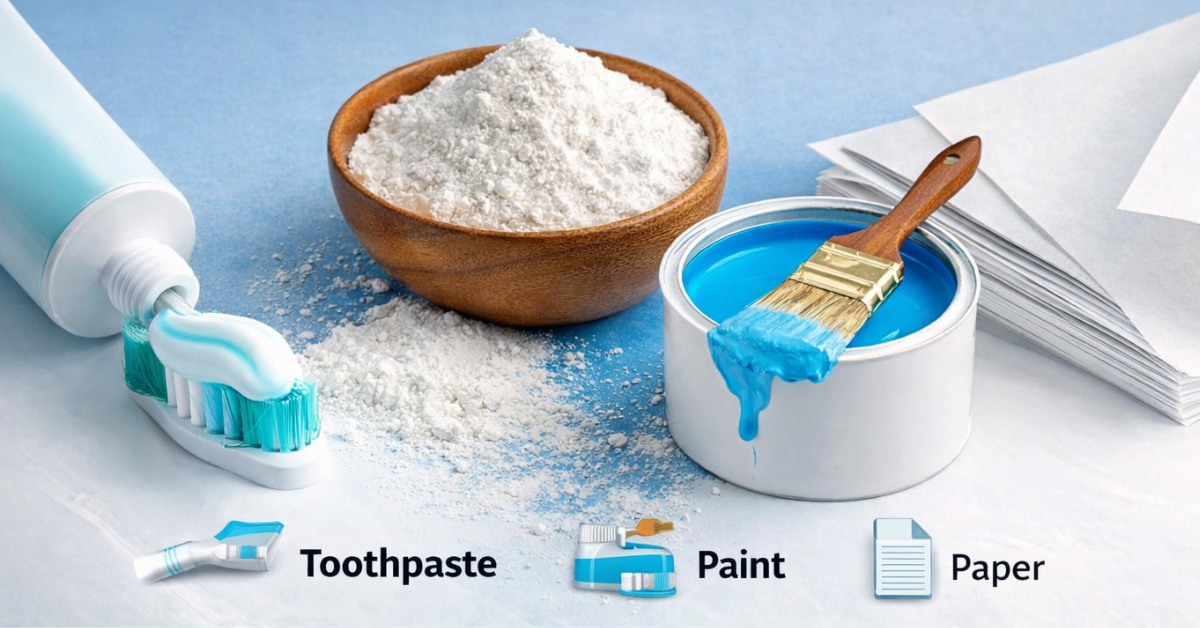
What’s Hiding in Your Toothpaste, Paint, and Paper? Discover Kaolin Clay in Everyday Life

Every morning, we go through the same routine: brushing our teeth, washing our face, and stepping onto smooth bathroom tiles. It all feels ordinary — familiar, routine, almost invisible.
But have you ever wondered what these everyday products have in common? The answer might surprise you: Kaolin clay.
This soft, white clay, formed from rocks over thousands of years, quietly works behind the scenes, making your products safe, effective, and sometimes even shiny. Let’s explore how.
Meet Kaolin Clay
Kaolin, also called China clay, is a naturally occurring mineral formed when granite and feldspar-rich rocks slowly break down under warm, humid conditions. Chemically, it’s mostly kaolinite, a stable, non-reactive mineral.
Why does this matter? Because its stability and fine texture make it perfect for everyday products without causing harm to your skin or environment.
Think of it as the overachiever in the mineral world: silent, reliable, and everywhere.
How Kaolin Touches Your Daily Life
You probably encounter Kaolin more often than you realize:
-
Toothpaste – a gentle abrasive that cleans without damaging your enamel
-
Face masks & skincare – absorbs oil while being mild on sensitive skin
-
Pharmaceutical tablets – act as a binder, holding medicine together safely
-
Glossy paper – gives shine, smoothness, and brightness
-
Wall paint – thickens and smooths out textures
-
Water filters – provide a functional layer that helps clean water
Check out this video for a visual explanation of how Kaolin clay shows up in everyday products:
Why Industries Rely on Kaolin?
Kaolin doesn’t complain, it just works. Industries love it for a few key reasons:
-
Chemically stable: it doesn’t react with other materials
-
Absorbent: handles moisture and oils effectively
-
Safe: low risk of irritation for skin or internal use
-
Abundant & natural: reduces dependence on synthetic alternatives
From toothpaste to paint, Kaolin is a quiet hero that improves texture, stability, and performance across multiple industries.
Emerging Applications
Kaolin’s versatility goes beyond traditional uses:
-
Eco-friendly packaging – safer alternatives to plastics
-
Nanotechnology and composites – materials innovation
-
Soil conditioning in sustainable agriculture – helps crops grow naturally
-
Advanced ceramics – industrial and design applications
Even though some applications like space skincare are still experimental, Kaolin continues to find new roles in modern science and technology.
A Geologist’s Perspective
As a geologist, what fascinates me most is Kaolin’s journey:
A rock forms deep in the Earth.
Weathering slowly transforms it into soft clay.
And one day, it ends up in your toothpaste, your face mask, or even on your bathroom tiles.
It’s a quiet reminder that geology doesn’t just live in mountains or maps — it lives in our daily routines and in products we often take for granted.
Conclusion
Kaolin clay is more than just a mineral; it’s a practical, Earth-derived solution that touches multiple aspects of our lives.
Next time you brush your teeth or open a skincare product, you’ll know there’s a little bit of Earth working silently for you.